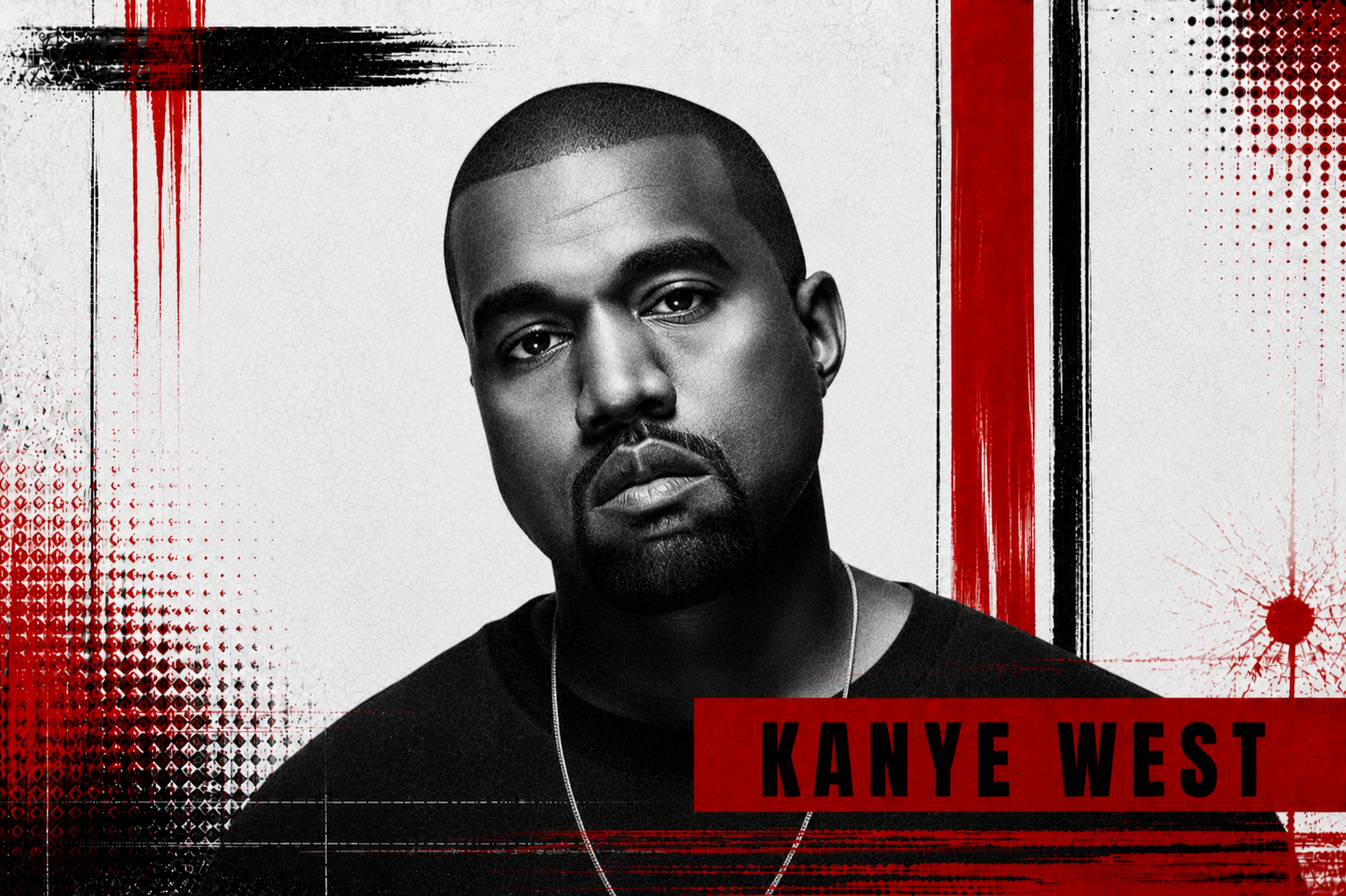
Kanye West Biography
Kanye West understands the preciousness of life. It was in October of 2002 that his was nearly abruptly taken from him. Driving back to his hotel late one night after a Los Angeles recording session, the acclaimed producer/burgeoning rapper was involved in a devastating, near fatal car accident in which he sustained injuries that left his jaw fractured in three places. News reports of the accident quickly spread throughout the music industry, and the disturbing image of the usually-slender West's suddenly bloated, severely bruised visage laid up in a hospital bed became indelibly ingrained in the conscience of a shocked rap nation.
"I have flashbacks of what happened everyday," Kanye confesses. "And anytime I hear about any accident my heart sinks in and I just thank God that I'm still here. That steering wheel could have been two inches further out, and that would have been it. You find out how short life is and how blessed you are to be here."
But a remarkable thing happened in the immediate aftermath of this tragedy. Kanye used the accident as inspiration for one of the most arresting and triumphant creative statements rap music has ever seen. Just weeks after skirting death, and with his jaw still literally wired shut, he recorded Through the Wire, a pointed and personal account of the events that resonates with uncanny wit and raw emotion.
Rhymes West: I must got a angel/ Cuz look like death missed his ass/ Unbreakable/ What you thought they call me Mr. Glass/ I look back on my life like the ghost of Christmas past/ Toys R Us where I used to spend that Christmas cash/ And I still won't grow up/ I'm a grown ass kid/ So I should be like other stupid shit that I did/ But I'm a champion/ So I turned tragedy to triumph/ Make music that's fire/ Spit my soul through the wires.
Very simply, the song marks the emergence of hip hop's most important new voice. Rap music's storied history has seen several artists play the dual roles of word wielder on the mic and trackmaster behind the boards. But if many have gained notoriety for their double duty activities, only a few have exerted a profound impact on the direction of the music overall. Add to the latter Kanye West. With his highly anticipated debut LP for Roc-A-Fella Records, College Dropout, acclaimed aural architect West not only produces, writes and performs his own music and lyrics, but presents himself as a thoroughly well rounded artist with a purpose and musical vision all his own.
"In hip hop people always have pre-conceived ideas about you when you¹re a producer who also rhymes," explains the 26 year old maestro. "But one of the main things I want to stress is that Stevie Wonder produced his own music. Prince produced his own music. Tyrone Davis and Bobby Womack all these different people. And you don't even think about the fact that they created their own songs. So I don¹t see what I do as being any different."
Heretofore known the sonic visionary behind such hits as Jay-Z's Izzo (H.O.V.A.), Girls, Girls, Girls, The Takeover, and '03 Bonnie & Clyde, Beanie Sigel's The Truth, Scarface's Guess Who's Back, and Talib Kweli's Get By, amongst many others, Chicago-bred West is undoubtedly one of most talented and accomplished young producers to have emerged in recent years.
After beginning his career co-producing songs for Mase's Harlem World, and the Madd Rapper, West caught his big break when his work attracted the attention of decision-makers at Jay-Z's Roc-A-Fella Records, who lauded his soulful approach to hip hop production. West-helmed hits frequently rely on vintage R&B samples ingeniously reconfigured for today's digital low end theories. First fully showcased on Jigga's 2001 classic, The Blueprint, Kanye's signature style has since rejuvenated the soundscape of rap music as a whole injecting warmth and melodic savvy where cold keyboards previously dominated
"I feel like a lot of the soul that's in those old records that I sample is in me," says the now tri-state residing transplant. "So when I hear them and I put them with the drums and I bring them to the new millennium it's just like God's doing that. I'm one with them records right there. It's a blessing. And best believe I saved some monsters for my album!"
Indeed, the soul that informs Kanye's tracks reaches another level on his material. Unbeknownst to those who may only be familiar with him via his boardsmanship, Kanye has rhymed avidly since his Chi-town days. So when Roc co-founder Damon Dash heard a demo of Kanye¹s solo songs in 2002, the young producer immediately joined to the label¹s stable of artists. Having achieved his professional success sans a university diploma (he dropped out of art school in Chicago after one year), Kanye explains the meaning of the album's title as setting your own goals in life and not letting anyone dictate what you need to do to be.
The College Dropout is a testament to such free-thinking, an astounding debut effort whose sensibilities runs the gamut from the insightful and inspirational to the infectious, comedic and clever. Exhibiting remarkable breadth, the album provides a wealth of surprises for anyone erroneously assuming West's music would go the way of a Roc-A-Fella cookie cutter copy.
For instance, When It All Falls Down, a track cleverly based around an indelible Lauryn Hill Unplugged vocal loop which addresses materialism in the Black community with self deprecating humor and honesty. Two Words featuring Mos Def, fellow Roc soldier Freeway, and the grand choral backing of the Harlem Boys Choir, which provides a majestic platform for Kanye and companies inspired, nearly entirely mono-syllabic wordplay. Elsewhere, Slow Jams, featuring actor/comedian/singer Jamie Foxx and fellow Second City vocal wonder Twista, hilariously lampoons quiet storm conventions without succumbing to novelty itself. The Good, the Bad, the Ugly finds Kanye and former Tribe Called Quest associate Consequence brilliantly trading fluid verses over mesmerizing Hi Records string lines. And the guitar-driven Breathe in Breathe Out featuring mouth of the south Ludacris is a playful club anthem containing no shortage of lyrical wit on Kanye's part: Golly, more of that bullshit ice rap/ I gotta apologize to Mos and Kweli/ But is it cool to rap about gold if I tell the world I copped it from Ghana and Mali?/ First nigga with a Benz and a backpack/ Ice chain Cardy lens and a knapsack/ I always said if I rapped I¹d say something significant/ But now I'm rapping 'bout money, hoes and rims again.
But perhaps most indicative of Kanye's determination to remain creative in the face of adversity is My Way, a song that impressively answers the haters and naysayers who may doubt his solo skills. Rhymes West over a sped up soul cover of the Paul Anka-penned classic of the same name: It goes my way/ Chi way/ This way or the highway/ Shots will lay you off on your day off like Friday/ The Roc got yay but they ain't snorting it/ They just got him up at Bassline recording shit/ Yeah I been broke/ Now I'm good, bitch/ I ain't no Kennedy/ But I'm hood rich/ So I say my way to take you to the ghetto/ And everybody else, thank you very little.
For a rap audience continually weaned on thug threats and ice worship, College Dropout, contrary to its title, provides an educational reminder of what it means to be compelling and human in hip hop. As one of a precious few rappers with actually something to say in his songs, Kanye is fully aware that his beats provide the best conduit to absorbing his not-so-trendy content. "The best thing about the fact that I did beats is I can make the perfect plateaus for me to present information over. I make music that'll catch people's ear automatically. Then when they hear what I'm saying they go, Oh shit, he saying some shit right there."
And even this collegiate dropout admits that as a vocalist he's learned some valuable lessons of his own while punching the clock at the Roc. "It's like if you wan to rap like Jay, it's hard to rap like Jay and not rap about what Jay is rapping about," says Kanye. "So what I did is incorporate all these different forms of rap together like I'll use old school patterns, I come up with new patterns in my head every day. Once I found out exactly how to rap about drugs and exactly how to rap about saying no to drugs," I knew that I could fill the exact medium between that. My persona is that I'm the regular person. Just think about whatever you've been through in the past week, and I have a song about that on my album."
In essence, Kanye West's music has arrived not just for the sake of defying expectations, but to express the truisms of every day life as no one in hip-hop has done before. "In music and society people tell you to pick a side," Kanye concludes. "Are you mainstream or underground? Do you rhyme about nice cars, or about riding the train? Are you ignorant or do you know something about history? But I'm a person who I can do all these different things. It's like everybody is taking that fork in the road. They don't see the rainbow in the middle. And I'm about to ride that. I'm the prism. And my music comes out in colors."
Kanye West All Music Guide Biography
From out of left field (i.e., Chicago, anything but a hip-hop hotbed), West was an unlikely sensation and more than once defied adversity. Like so many others who were initially inspired by Run-D.M.C., he began as just another aspiring rapper with a boundless passion for hip-hop, albeit a rapper with a Midas touch when it came to beatmaking. And it was indeed his beatmaking skills that got his foot in the industry door. Though he did quite a bit of noteworthy production work during the late '90s (Jermaine Dupri, Foxy Brown, Mase, Goodie Mob), it was his work for Roc-a-Fella at the dawn of the new millennium that took his career to the next level. Alongside fellow fresh talent Just Blaze, West became one of The Roc's go-to producers, consistently delivering hot tracks to album after album. His star turn came on Jay-Z's classic Blueprint (2001) with album standouts "Takeover" and "Izzo (H.O.V.A.)." Both songs showcased West's signature beatmaking style of the time, which was largely sample-based -- in these cases the former track appropriating snippets of the Doors' "Five to One," the latter the Jackson 5's "I Want You Back."
More high-profile productions followed, and before long word spread that West was going to release an album of his own, on which he'd rap as well as produce. Unfortunately, that album was a long time coming, pushed back and then pushed back again. It didn't help, of course, that West experienced a tragic car accident in October 2002 that almost cost him his life. He capitalized on the traumatic experience by using it as the inspiration for "Through the Wire" (and its corresponding video), which would later become the lead single for his debut album, The College Dropout (2004). As the album was continually delayed, West continued to churn out big hits for the likes of Talib Kweli ("Get By"), Ludacris ("Stand Up"), Jay-Z ("'03 Bonnie & Clyde"), and Alicia Keys ("You Don't Know My Name"). Then, just as "Through the Wire" was breaking big-time at the tail end of 2003, another West song caught fire, a collaboration with Twista and comedian/actor Jamie Foxx called "Slow Jamz" that gave the rapper/producer two simultaneously ubiquitous singles and a much-anticipated debut album. As with so many of West's songs, these two were driven by somewhat recognizable sample-based hooks -- Chaka Khan's "Through the Fire" in the case of "Through the Wire," and Luther Vandross' "A House Is Not a Home" in the case of "Slow Jamz."
In the wake of his breakout success, West earned a whopping ten nominations for the 47th annual Grammy Awards, held in early 2005. The College Dropout won the Best Rap Album award, "Jesus Walks" won Best Rap Song, and a songwriting credit on "You Don't Know My Name" for Best R&B Song award was shared with Alicia Keys and Harold Lilly. Later in the year, West released his second solo album, Late Registration (2005), which spawned a series of hit singles ("Diamonds in Sierra Leone," "Gold Digger," "Heard 'Em Say," "Touch the Sky"), topped the charts (as did "Gold Digger"), and won a Grammy for Album of the Year. West's production work continued more or less unabated during this time; particularly noteworthy were hits for Twista ("Overnight Celebrity"), Janet Jackson ("I Want You"), Brandy ("Talk About Our Love"), the Game ("Dreams"), Common ("Go!"), and Keyshia Cole ("I Changed My Mind"). West also founded his own label, GOOD Music (i.e., "Getting Out Our Dreams"), in conjunction with Sony BMG. The inaugural release was John Legend's Get Lifted (2004), followed by Common's Be (2005). In addition to all of his studio work, West also toured internationally in support of Late Registration and released Late Orchestration: Live at Abbey Road Studios (2006) in commemoration.
After retreating from the spotlight for a while, West returned to the forefront of the music world in 2007 with a series of album releases. Consequence's Don't Quit Your Day Job and Common's Finding Forever, both released by GOOD, were chiefly produced by West; the latter was particularly popular, topping the album chart upon its release in July. And then there was West's third solo album, Graduation, which was promoted well in advance of its September 11 release (a memorable date that pitted Kanye against 50 Cent, who in one interview swore he would quit music if his album, Curtis, wasn't the top-seller). A pair of singles -- "Can't Tell Me Nothing" and "Stronger," the latter an interpolation of Daft Punk's 2001 single "Harder, Better, Faster, Stronger" -- led the promotional push. It became his third consecutive number one album, and it led to eight Grammy nominations. He was the victor in four of the categories, and he performed two songs, including Late Registration's "Hey Mama," chosen in honor of his recently deceased mother. That loss, compounded by a breakup with his fiancée, informed 2008's 808s & Heartbreak, a major change of pace that saw West singing most of his emotionally pained lyrics with the assistance of Auto-Tune. ~ Jason Birchmeier, All Music Guide


Plus