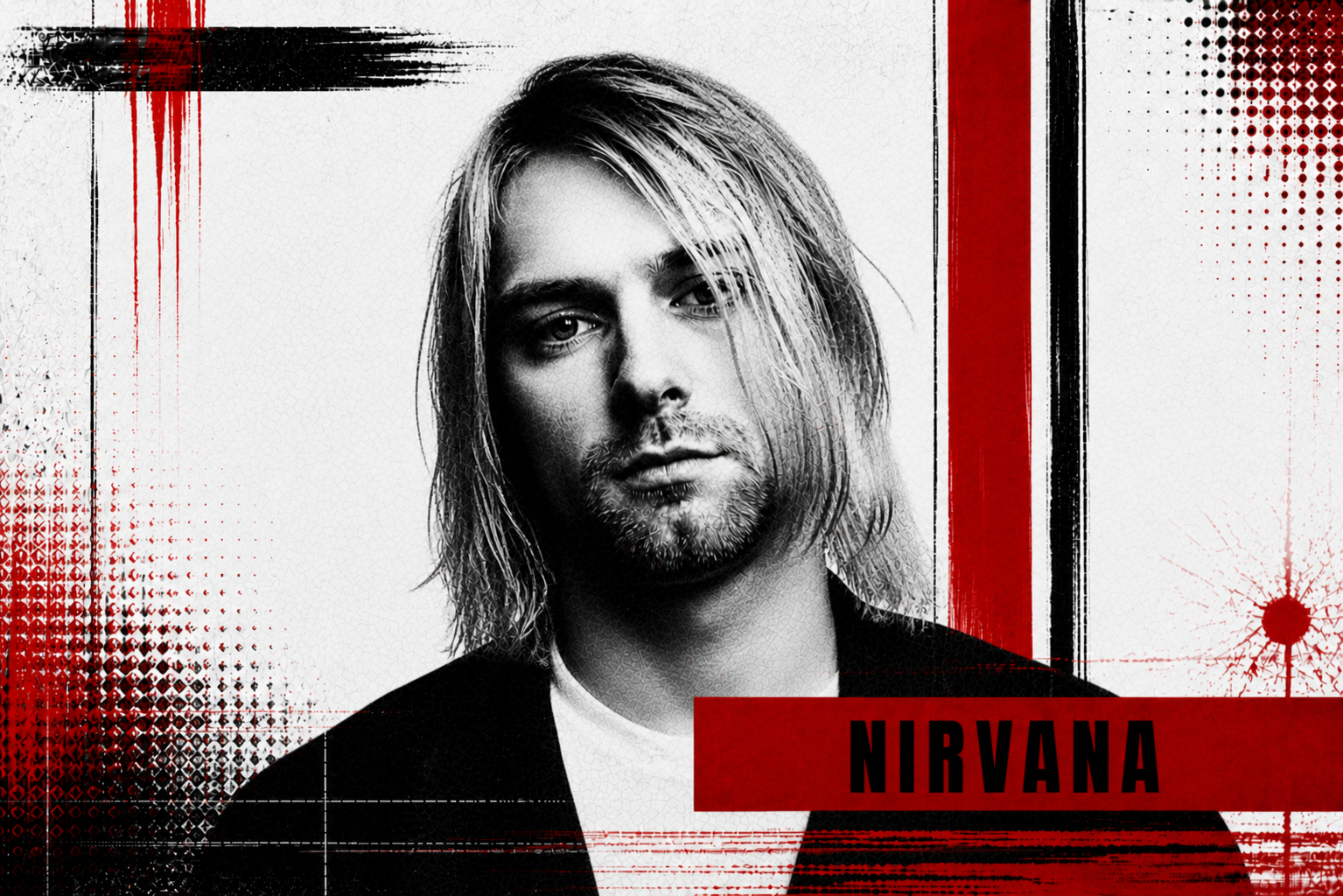
Nirvana Biography
Nirvana's story begins in Aberdeen, Wash., where Kurt Cobain and Krist Novoselic spent their adolescent years. The logging town The pair eventually formed their own band, Nirvana, in 1986, anchoring an ever- The hype in England was based on substance. Nirvana's performances were ferocious, drenched in distortion and feedback, and often culminated in smashed guitars and broken drum kits. The band toured constantly from its inception, and fanzine reviews and word- Nirvana's first full- While Nirvana's star was on the rise, lineup changes continued to plague the band. Bleach not only featured two different drummers, but the band photo on the album included guitarist Jason Everman, who didn't actually play on it (his only studio stint with Nirvana was a cover of KISS's "Do You Love Me?" recorded for a tribute album). As for drummers, the Melvins' Dale Crover served briefly in January of 1988, recording demos with Cobain and Novoselic before moving to San Francisco. A couple of other drummers passed through before Chad Channing took over the drum stool in the spring of 1988. He left following the band's May 1990 U.S. tour. Crover then filled in briefly, as did Mudhoney's Dan Peters, for exactly one gig, though he did play on the band's last Sub Pop single, "Sliver." The trio's fourth and final drummer, Dave Grohl, joined in October of 1990 (see the Foo Fighters) and Nirvana's power- Far better realized and produced than its predecessor, Nevermind is the rare album that manages to be both accessible and uncompromising. At the behest of their friends in Sonic Youth, Nirvana agreed to sign with DGC Records (a division of Geffen Records) in April of 1991. Their advance of $287,000 was quickly divided up to pay debts, taxes, and various fees, but Nirvana had negotiated for and received full artistic control, as well as a high royalty rate if their next album reached sales of 500,000. They recorded in Van Nuys, California, early that summer with producer Butch Vig, with whom the band had cut demos in April of the previous year. Vig (who went on to form his own successful band, Garbage) helped bring the band a more polished sound that added clarity and resonance to Cobain's voice, while Grohl's muscular drumming gave Nirvana a punch it had always lacked. Still, the sessions weren't too slick; Cobain relied on a battered old guitar that wouldn't stay in tune to record the mournful strains of "Something in the Way." Nevermind has moments of quiet subtlety, but blustery hard rock with hooks dominates the album. "Come As You Are," "On a Plain," and "Drain You" all revolve around simple motifs, power chords, and keen musicianship. Those qualities are shared by another song, "Smells Like Teen Spirit." Although Cobain sang the song's words nearly indecipherably, it quickly became a wake- Nevermind was released September 24, 1991, and was certified gold (sales of over 500,000) less than a month later. On the strength of a clever "Teen Spirit" video (directed by Samuel Bayer) and heavy radio airplay, the album hit No. 1 in February of 1992. Nirvana crowned their achievement by appearing on Saturday Night Live, where Cobain and Novoselic kissed as the credits rolled, mocking legions of new fans As 1992 wore on, Nirvana continued to tour, and turmoil began to swirl around the band. Rumors about Kurt Cobain's use of heroin reached a fever pitch when Vanity Fair magazine published a cover story on Courtney Love, whom Cobain had married in February. The article alleged that Love took heroin after she discovered she was pregnant, which the couple vehemently denied. Courtney Love gave birth to a girl, Frances Bean, on August 18, 1992. The controversy quieted in time, but still had a major influence on In Utero, the band's third album, released in September of 1993. Less conventional than its predecessor, In Utero had a raw, powerful sound due in part to producer Steve Albini's recording techniques, which captured the band playing live in the studio without overdubs. On the album, Cobain addressed the lingering effects of sudden fame in "Serve the Servants," and hit back at Lynn Hirschberg, author of the Vanity Fair article, in "Rape Me." In Utero closed with "All Apologies," in which the singer questioned how things could have been different. He ended the song with a seeming note of acceptance as the song fades: "All in all is all we are." With the release of In Utero, Nirvana sat for a major interview with Rolling Stone, in which Cobain spoke of fatherhood, fame, the future, and laying his demons to rest. The band began a three- Sadly, in early 1994, problems returned for Nirvana when Kurt Cobain took a near- Kurt Cobain's death meant the end of Nirvana, leaving numbness where there had been so much promise. After periods of mourning, Dave Grohl took up the guitar and formed Foo Fighters, while Krist Novoselic devoted time to public policy in Washington State and his new band, Sweet 75. Nirvana's legacy was expanded in 1994 by the release of Unplugged in New York, taken from their acoustic MTV set, and a video compilation. In 1996, an electric live album, From the Muddy Banks of the Wishkah, was released, and will likely serve as the final statement from the band.
Nirvana All Music Guide Biography
Kurt Cobain (vocals, guitar) met Chris Novoselic (born Krist Novoselic) (bass) in 1985 in Aberdeen, WA, a small logging town 100 miles away from Seattle. While Novoselic came from a relatively stable background, Cobain's childhood had been thrown into turmoil when his parents divorced when he was eight. Following the divorce, he lived at the homes of various relatives, developing a love for the Beatles and then heavy metal in the process. Eventually, American hardcore punk worked its way into dominating his listening habits and he met the Melvins, an Olympia-based underground heavy punk band. Cobain began playing in punk bands like Fecal Matter, often with the Melvins' bassist Dale Crover. Through the Melvins' leader Buzz Osborne, Cobain met Novoselic, who also had an intense interest in punk, which meant that he, like Cobain, felt alienated from the macho, redneck population of Aberdeen. The duo decided to form a band called the Stiff Woodies, with Cobain on drums, Novoselic on bass, and a rotating cast of guitarists and vocalists. The group went through name changes as quickly as guitarists, before deciding that Cobain would play guitar and sing. Renamed Skid Row, the new trio featured drummer Aaron Burkhart, who left the band by the end of 1986 and was replaced by Chad Channing. By 1987, the band was called Nirvana.
Nirvana began playing parties in Olympia, gaining a cult following. During 1987, the band made ten demos with producer Jack Endino, who played the recordings to Jonathan Poneman, one of the founders of the Seattle-based indie label Sub Pop. Poneman signed Nirvana, and in December of 1988, the band released their first single, a cover of Shocking Blue's "Love Buzz." Sub Pop orchestrated an effective marketing scheme, which painted the band as backwoods, logging-town hicks, which irritated Cobain and Novoselic. While "Love Buzz" was fairly well-received, the band's debut album, Bleach, was what began the ball rolling. Recorded for just over 600 dollars and released in the spring of 1989, Bleach slowly became a hit on college radio, due to the group's consistent touring. Though Jason Everman was credited as a second guitarist on the sleeve of Bleach, he didn't appear on the record; he only toured in support of the album before leaving the band at the end of the year to join Soundgarden and then Mindfunk. Bleach sold 35,000 copies and Nirvana became favorites of college radio, the British weekly music press, and Sonic Youth, Mudhoney, and Dinosaur Jr., which was enough to attract the attention of major labels.
During the summer, Nirvana released "Sliver"/"Dive," which was recorded with Mudhoney's Dan Peters on drums and produced by Butch Vig. The band also made a six-song demo with Vig, which was shopped to major labels, who soon began competing to sign the group. By the end of the summer, Dave Grohl, formerly of the D.C.-based hardcore band Scream, had become Nirvana's drummer and the band signed with DGC for $287,000. Nirvana recorded their second album with Vig, completing the record in the summer. Following a European tour supporting Sonic Youth in the late summer, Nevermind was released in September, supported by a quick American tour. While DGC was expecting a moderately successful release, in the neighborhood of 100,000 copies, Nevermind immediately became a smash hit, quickly selling out its initial shipment of 50,000 copies and creating a shortage across America. What helped the record become a success was "Smells Like Teen Spirit," a blistering four-chord rocker that was accompanied by a video that shot into heavy MTV rotation. By the beginning of 1992, "Smells Like Teen Spirit" had climbed into the American Top Ten and Nevermind bumped Michael Jackson's much-touted comeback album Dangerous off the top of the album charts; it reached the British Top Ten shortly afterward. By February, the album had been certified triple platinum.
Nirvana's success took the music industry by surprise, Nirvana included. It soon become apparent that the band wasn't quite sure how to handle their success. Around the time of Nevermind's release, the band was into baiting their audience -- Cobain appeared on MTV's Headbanger's Ball in drag, the group mocked the tradition of miming on the BBC's Top of the Pops by Novoselic constantly throwing his bass into the air and Cobain singing his live vocals in the style of Ian Curtis, and their traditional live destruction of instruments was immortalized on a Saturday Night Live performance that ended with Novoselic and Grohl sharing a kiss -- but by the spring, questions had begun to arise about the band's stability. Cobain married Courtney Love, the leader of the indie rock/foxcore band Hole, in February of 1992, announcing that the couple was expecting a child in the fall. Shortly after the marriage, rumors that the couple were heavy heroin users began to circulate and the strength of the rumors only increased when Nirvana canceled several summer concerts and refused to mount a full-scale American tour during the summer. Cobain complained that he was suffering from chronic stomach troubles, which seemed to be confirmed when he was admitted to a Belfast hospital after a June concert. But, heroin rumors continued to surface, especially in the form of a late-summer Vanity Fair article which implied that Love was using during her pregnancy. Both Love and Cobain denied the article's allegations, and publicly harassed and threatened the article's author. Love delivered Frances Bean Cobain, a healthy baby girl, on August 18, 1992, but the couple soon battled with Los Angeles' children's services, who claimed they were unfit parents on the basis of the Vanity Fair article. The couple was granted custody of their child by the beginning of 1993.
Since Cobain was going through such well-documented personal problems, Nirvana was unable to record a follow-up to Nevermind until the spring of 1993. In the meantime, DGC released the odds-and-ends compilation Incesticide late in 1992; the album reached number 39 in the U.S. and number 14 U.K. As the group prepared to make their third album, they released "Oh, the Guilt" as a split-single with the Jesus Lizard on Touch & Go Records. Choosing Steve Albini (Pixies, the Breeders, Big Black, the Jesus Lizard) as their producer, Nirvana recorded their third album, In Utero, in two weeks during the spring of 1993. Following its completion, controversy began to surround Nirvana again. Cobain suffered a heroin overdose on May 2, but the event was hidden from the press. The following month, Love called police to their Seattle home after Cobain locked himself in the bathroom, threatening suicide. Prior to debuting In Utero material during the New Music Seminar at New York's Roseland Ballroom in July, Cobain had another covered-up overdose. By that time, reports began to circulate, including an article in Newsweek, that DGC was unhappy with the forthcoming album, accusing that the band deliberately made an uncommercial record. Both the band and the label denied such allegations. Deciding that Albini's production was too flat, Nirvana decided to remaster the album with R.E.M.'s producer, Scott Litt.
In Utero was released in September of 1993 to positive reviews and strong initial sales, debuting at the top of the U.S. and U.K. charts. Nirvana supported it with a fall American tour, hiring former Germs member Pat Smear as an auxiliary guitarist. While the album and the tour were both successful, sales weren't quite as strong as expected, with several shows not selling out until the week of the concert. As a result, the group agreed to play MTV's acoustic Unplugged show at the end of the year, and sales of In Utero picked up after its December airing. After wrapping up the U.S. tour on January 8, 1994, with a show at Center Arena in Seattle, Nirvana embarked on a European tour in February. Following a concert in Munich on February 29, Cobain stayed in Rome to vacation with Love. On March 4, she awakened to find that Cobain had attempted suicide by overdosing on the tranquilizer Rohypnol and drinking champagne. While the attempt was initially reported as an accidental overdose, it was known within the Nirvana camp that the vocalist had left behind a suicide note.
Cobain returned to Seattle within a week of his hospitalization and his mental illness began to grow. On March 18, the police had to again talk the singer out of suicide after he locked himself in a room threatening to kill himself. Love and Nirvana's management organized an intervention program that resulted in Cobain's admission to the Exodus Recovery Center in L.A. on March 30, but he escaped from the clinic on April 1, returning to Seattle. His mother filed a missing persons report on April 4. The following day, Cobain shot himself in the head at his Seattle home. His body wasn't discovered until April 8, when an electrician contracted to install an alarm system at the Cobain house stumbled upon the body. After his death, Kurt Cobain was quickly anointed as a spokesman for Generation X, as well as a symbol of its tortured angst.
Novoselic and Grohl planned to release a double-disc live album at the end of 1994, but sorting through the tapes proved to be too painful, so MTV Unplugged in New York appeared in its place. The album debuted at the top of the British and American charts, as a home video comprised of live performances and interviews from the band's Nevermind-era, titled Live! Tonight! Sold Out!, was issued at the same time (the project began prior to Cobain's passing and was completed by surviving bandmembers).
In 1996, its electric counterpart, From the Muddy Banks of the Wishkah, was released, debuting at the top of the U.S. charts. Following Cobain's death, Grohl formed the Foo Fighters (early rumors that Novoselic would also be a member of the band ultimately proved to be false) -- releasing their self-titled debut album in 1995, followed by The Colour and the Shape in 1997 and There Is Nothing Left to Lose in 1999. Novoselic formed the trio Sweet 75, releasing their debut in the spring of 1997, and also appeared along with former Dead Kennedys' frontman Jello Biafra and former Soundgarden guitarist Kim Thayil on the 2000 live set Live From the Battle in Seattle under the name the No W.T.O. Combo.
By the late '90s, research began by Novoselic for a proposed box set of previously unreleased songs from throughout Nirvana's career. The project was supposed to surface in the fall of 2001 (to coincide with the tenth anniversary release of Nevermind), but legal problems began to surface. In 1997, Grohl and Novoselic formed the Nirvana L.L.C. partnership with Courtney Love (who manages Cobain's estate) -- a company that required a unanimous vote by all three regarding future albums, photos, and anything else Nirvana-related. When all three couldn't agree on the songs to be included on the box set, the matter was taken to court as Love attempted to dissolve the partnership. The project was ultimately shelved indefinitely as any legal decision was tied up in court. ~ Stephen Thomas Erlewine & Greg Prato, All Music Guide


Plus