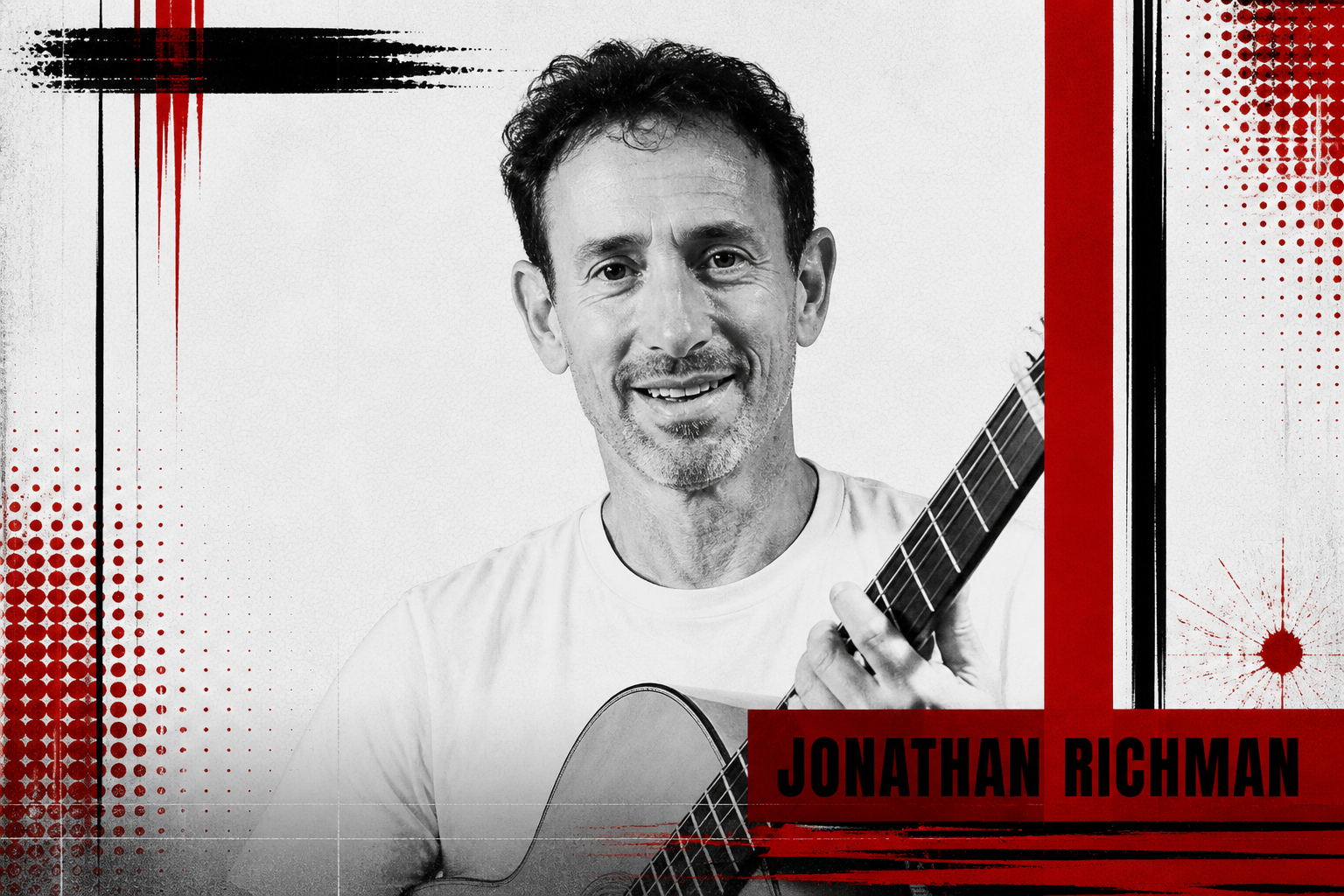
Jonathan Richman Biography
Jonathan Richman has been writing songs, making records and performing live for most of his life, winning fans and making friends around the world with his guileless honesty and playfully catchy compositions. He's revered by countless fellow artists, and has built a remarkably loyal international audience through his tireless touring. His deceptively straightforward songs embody timeless qualities of humanity, optimism, emotional insight and a boundless sense of humor, untainted by cynicism or transient notions of hipness.
Those qualities are all prominent on Not So Much to Be Loved as to Love, to be released on Sanctuary Records this summer, Jonathan Richman's 21st album and his first collection of new material in three years. The album features thirteen openhearted, lovingly crafted songs (fifteen if you count the two unlisted bonus tracks), delivered in spare but often imaginative arrangements built around Jonathan's distinctive voice and guitar and the sensitive drumming of longtime sideman Tommy Larkins. The resulting album captures much of the warmth of Jonathan's exuberant, spontaneous and often hilarious live performances.
Not So Much to Be Loved as to Love—the follow up to Jonathan's 2003 live DVD Take Me to the Plaza—features a typically winsome set of tunes. "Sunday Afternoon," "He Gave Us the Wine to Taste It," "Behold the Lilies of the Field" and the title track exemplify his life-affirming attitude, while "Vincent Van Gogh" and "Salvador Dali" continue his longstanding tradition of paying poignant tribute to his heroes. Elsewhere, Jonathan ventures into uncharacteristically topical territory on the moving plea "Abu Jamal," and his longstanding interest in international culture manifests itself in songs sung in Italian ("Cosi Veloce," "In Che Mondo Viviamo") and French ("Les Etoiles" and "On a du Soleil").
The album also features a guest appearance from bassist Greg "Curly" Keranen, a former member of Richman's fabled '70s band the Modern Lovers, on standup bass; noted multi-instrumentalist Ralph Carney on flute and trumpet; and bassist Miles Montalbano, who also designed the album's cover art.
Not So Much to Be Loved as to Love is also Jonathan Richman's first completely self-produced album. "I'm the most satisfied with the sound of this record than of any of my records," he reports. "I feel like we're just starting to get the hang of getting the sound right. I think I've always been mainly a stage performer kind of guy, so it took me a while to feel comfortable in the studio, but now I'm getting there. In this case it was actually easier to produce my own stuff, because this time I knew what I wanted, and it was easier for me to do it myself than to try to explain to another guy."
While he may feel that he's just coming to grips with the recording medium, the records that Jonathan Richman has made over the past 30 years have long held a special place in the hearts of his fans. He began playing guitar at the age of 15, and in the early 1970s formed the Modern Lovers, whose raw, minimalist sound and emotionally forthright songs helped to lay the groundwork for punk rock. But by the time the group's landmark debut album (including the much-covered "Road Runner," a Top Five single in Europe) was released in 1976, Jonathan had already moved on to a quieter sound and a gentler lyrical focus. Since then, he's continued to record and tour prolifically, first with a series of Modern Lovers lineups, later on his own, and eventually as a duo with drummer Larkins. Over the years, Jonathan's music has absorbed a multitude of influences, from doo-wop to country to a variety of international styles, without sacrificing the artist's effervescent personality.
Jonathan's fans have remained fiercely devoted over the years, and his audience expanded substantially in the 1990s, thanks to his frequent guest spots on TV's Late Night with Conan O'Brien, his prominent appearance in the 1998 film comedy smash There's Something About Mary, and the inclusions of his Modern Lovers classics "Ice Cream Man" and "I'm A Little Airplane" on Sesame Street.
For much of his career, Jonathan has toured almost almost nonstop around the world. "Traveling and playing for new people in new places is one of my favorite things," he notes. "It's great playing places that are off the beaten track. You can learn a lot when you play in a little town in Holland or Western Australia, and you learn different things than you would learn playing a big city. This year we're going to try to play in Extremadura, which is the southwest of Spain—we might become the first American entertainers ever to play there. I'm hoping that we can able to play the Canary Islands soon.
"Playing shows and making records keeps been getting easier and more fun," Jonathan states, adding, "Me and Tommy play totally different than we played two years ago. We already play a different style than we played on that live DVD, and the way we played then was totally different from the way we played three years before that. I still feel like we're just starting out, and I still learn new stuff every night."
Jonathan Richman All Music Guide Biography
Jonathan Richman was one of rock's most eccentric and unpredictable cult figures, a performer whose eternally childlike public persona and seeming naiveté -- typified by songs like "Ice Cream Man," "Hey There Little Insect" and "I'm a Little Aeroplane" -- tended to obscure the dexterity and craft of his music, which skirted from garage rock to country to Latin stylings and back. Born May 15, 1951 in Boston, Massachusetts, Richman began playing guitar at the age of 15, and within a year was making his first public appearances. In 1969 he relocated to New York, the home of the Velvet Underground (his central musical influence), and spent his first two weeks in the city sleeping on the Velvets' manager's couch.
While working a series of odd jobs, including a tenure as a foot messenger for Esquire magazine, Richman attempted to find a venue to perform his music, but his simple songs and adenoidal voice were roundly rejected; he ultimately moved back to Boston in 1970, where he formed the first incarnation of the influential proto-punk band the Modern Lovers with guitarist John Felice, drummer David Robinson and bassist Rolfe Anderson. Within a few months, Anderson had been replaced by Ernie Brooks, and keyboardist Jerry Harrison stepped in for Felice. After recording some demos with Kim Fowley in the spring of 1971 (unissued until 1981), in 1973, the Modern Lovers (with producer John Cale) recorded the demos which comprised their seminal self-titled debut, featuring long-standing Richman favorites like "Roadrunner," "Pablo Picasso" and "Hospital." Problems with their label, however, blocked the songs' release until 1976; at the same time, Richman wanted to quiet the group's minimalist, garagey sound, leading to their breakup in 1973.
Eventually, Richman formed a new, acoustic Modern Lovers with guitarist Leroy Radcliffe, Rubinoos bassist Greg "Curly" Keranen and drummer Robinson. In 1977, they debuted with Jonathan Richman & the Modern Lovers, which emphasized the doo-wop flavor and wry pop melodies that remained hallmarks of Richman's career. That same year, the group issued Rock 'N' Roll With the Modern Lovers (with D. Sharpe on drums) and scored a major European hit with the instrumental "Egyptian Reggae." A year later, Richman went solo, and in 1979 issued Back in Your Life.
After a period of self-imposed exile, he resurfaced in 1983 with Jonathan Sings A series of strong pop records followed, including 1985's Rockin' & Romance, 1986's It's Time for Jonathan Richman & the Modern Lovers (recorded with Andy Paley), and Modern Lovers 88. In 1990, he released the self-explanatory Jonathan Goes Country; later, he made another left turn with 1993's Jonathan, Te Vas a Emocionar!, a collection of Latin-influenced songs performed entirely in Spanish. No matter what path his music took, however, Richman's cult following remained fiercely loyal, and saw its ranks expand courtesy of his frequent appearances on the NBC program Late Night With Conan O'Brien; in 1998, he was also prominently featured in the hit film comedy There's Something About Mary. I'm So Confused appeared later that year. Richman began dipping his toes into slightly more sophisticated musical forms with 2001's Her Mystery Not of High Heels and Eye Shadow, which also documented his continuing interest in the Spanish language, as did 2004's Not So Much to Be Loved as to Love. ~ Jason Ankeny, All Music Guide
While working a series of odd jobs, including a tenure as a foot messenger for Esquire magazine, Richman attempted to find a venue to perform his music, but his simple songs and adenoidal voice were roundly rejected; he ultimately moved back to Boston in 1970, where he formed the first incarnation of the influential proto-punk band the Modern Lovers with guitarist John Felice, drummer David Robinson and bassist Rolfe Anderson. Within a few months, Anderson had been replaced by Ernie Brooks, and keyboardist Jerry Harrison stepped in for Felice. After recording some demos with Kim Fowley in the spring of 1971 (unissued until 1981), in 1973, the Modern Lovers (with producer John Cale) recorded the demos which comprised their seminal self-titled debut, featuring long-standing Richman favorites like "Roadrunner," "Pablo Picasso" and "Hospital." Problems with their label, however, blocked the songs' release until 1976; at the same time, Richman wanted to quiet the group's minimalist, garagey sound, leading to their breakup in 1973.
Eventually, Richman formed a new, acoustic Modern Lovers with guitarist Leroy Radcliffe, Rubinoos bassist Greg "Curly" Keranen and drummer Robinson. In 1977, they debuted with Jonathan Richman & the Modern Lovers, which emphasized the doo-wop flavor and wry pop melodies that remained hallmarks of Richman's career. That same year, the group issued Rock 'N' Roll With the Modern Lovers (with D. Sharpe on drums) and scored a major European hit with the instrumental "Egyptian Reggae." A year later, Richman went solo, and in 1979 issued Back in Your Life.
After a period of self-imposed exile, he resurfaced in 1983 with Jonathan Sings A series of strong pop records followed, including 1985's Rockin' & Romance, 1986's It's Time for Jonathan Richman & the Modern Lovers (recorded with Andy Paley), and Modern Lovers 88. In 1990, he released the self-explanatory Jonathan Goes Country; later, he made another left turn with 1993's Jonathan, Te Vas a Emocionar!, a collection of Latin-influenced songs performed entirely in Spanish. No matter what path his music took, however, Richman's cult following remained fiercely loyal, and saw its ranks expand courtesy of his frequent appearances on the NBC program Late Night With Conan O'Brien; in 1998, he was also prominently featured in the hit film comedy There's Something About Mary. I'm So Confused appeared later that year. Richman began dipping his toes into slightly more sophisticated musical forms with 2001's Her Mystery Not of High Heels and Eye Shadow, which also documented his continuing interest in the Spanish language, as did 2004's Not So Much to Be Loved as to Love. ~ Jason Ankeny, All Music Guide


Plus