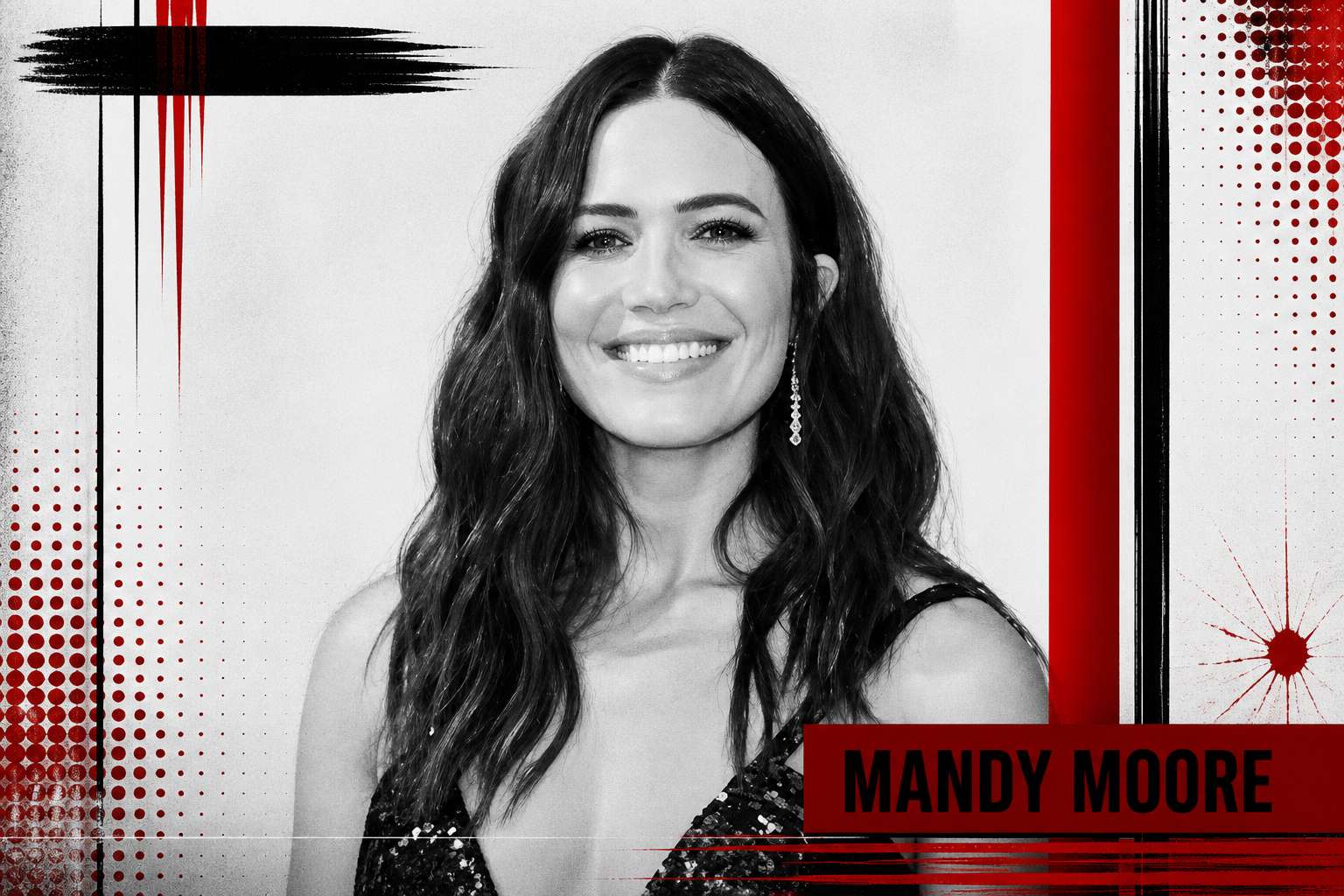
Mandy Moore

Mandy Moore Biography

"It's somewhat of a foreign concept for me to care so much about a record," Mandy Moore says. "I really haven't had the personal involvement on anything in the past, not like I do with this one."

Moore is proudly referring to her new album, Wild Hope, which she co-wrote with Lori McKenna, the Weepies, Rachael Yamagata and a slew of other critically acclaimed singer-songwriters. Recorded at Allaire Studios and produced by John Alagia, the man behind the boards on John Mayer’s 2001 debut "Room for Squares', Wild Hope is slated for a Spring ’07 release via The Firm Music.

In one sense, Moore's album is a collection of songs -- completed and compiled over a lengthy period of time, a project on which a pop artist lavishes overwhelming amounts of her energy, conviction, attention, and heart -- such as appears regularly in the ever-ongoing pop-music marketplace.

But for the New Hampshire-born, Orlando-raised 22-year-old, this particular release and how it was accomplished represents something decidedly new. When she discusses it, pride, relief and wonder streak her talk.

"I think that there's a time and a place for some of my past efforts," Moore says, referring to her albums released between 1999 and 2002 during the last years of '90s teen-pop. However, these days, Moore's concern is only to align herself with music she loves and believes in.

She continues: "Teenpop was a great platform to start from; I'm not someone who regrets anything. But in those days, I was just given songs and told to go into the studio and record them. Yet, I think that as you get older, you change and so do your musical tastes. And not to have those changes reflected in the music I was so involved with was very disheartening to me."

A head-shaking sense of incomprehension comes into Moore's characteristically upbeat speaking voice. "It just didn't seem like the proper situation."

For the past two years, making her new album, Mandy Moore insisted upon the proper situation. Exemplified by her current association with The Firm and the L.A. management company's innovative recent label, done in conjunction with EMI Music and designed to restructure prevailing royalty arrangements to benefit artists more closely, was conceived to facilitate this.

In her way, Moore started to insist upon it in 2003, when she released 'Coverage', a unique collection on which she tackled songs by some of the greatest songwriters in Anglo-American pop-rock history -- artists such as Joni Mitchell and Joan Armatrading -- from her own youthful and adulatory point of view.

"'Coverage' was the beginning of putting the real me out there," Moore says. "I was just so in love with the music, and wanted to enlighten every kid out there who didn't realize how great Joe Jackson and Todd Rundgren were."

Though for her new album, on which Moore also collaborated with James Renald and Chantal Kreviazuk, Moore was determined to write her own material. It became an unnegotiable demand she placed on both herself and everyone she worked with or planned to work with. "I was not willing to change the course of this record," Moore says. "It meant too much to me."

The project, moreover, had begun to take shape in Moore's ambitious mind, alongside her accumulating experience as a film actor. As she began to appear in movies such as 'A Walk to Remember' (2002), the critically acclaimed, 'Saved’ (2005) and the Paul Weitz film, ‘American Dreamz’(2006) and began to come into creative contact with people like John Turturro, Michael Stipe, Susan Sarandon, Billy Crudup, and many others, these experiences and relationships began to encourage and help bring out in herself what was always a more vital instinct that Moore had toward pop music.

"It all became linked to the choices that I was making in movies," Moore says. "As an actor, you have substantial control with the films you take on: If you never want to do an action movie, you don't have to. If you don't want to do nudity, you don't have to. It's case-by-case, project-by-project. For me all this went hand-in-hand with my music. I can't go off and do a movie with Diane Keaton, Mia Farrow, Billy Crudup or Tom Wilkinson and then come back to make a record where I, as a creative matter, am absent."

For Moore, this was just plain logic. "I knew that I wanted to work with Lori McKenna, Rachael Yamagata and the Weepies. This is what the record needed to be, and partly why it took two years to make. It's been a very interesting and rewarding process. My head is still spinning."

On Moore's new album, she sings -- with newly found clarity, conviction, and tone -- beautifully lucid and detailed melodies that convey essential aspects of how it feels, as she puts it, to be "a young woman figuring out life and where she fits into the scheme of things about love, relationships, and about being disappointed." Moore wrote songs like "All Good Things" and "Looking Forward to Looking Back" with the Weepies, in collaborations that, on both personal and musical levels, Moore treasures. Other songs, such as "Most of Me," she wrote with McKenna, “Ladies Choice” with Yamagata and the breathtaking ballad, "Gardenia," with Chantal Kreviazuk, in equally successful collaborations. All of these people were making music that Moore loved.

"With all of these artists" she says, "it was a matter of discovering their music and asking myself, 'Why isn't this the biggest thing since sliced bread? Why isn't Rachael Yamagata all over the radio? Did the Weepies actually not have a top-10 record? What about the great voice and the great storytelling of Lori McKenna? To me, this was all so accessible, so wonderfully creative and beautiful."

The biggest difference with the collection of songs on Wild Hope, Moore says, is that this time the words she sings are her own. By this point, Mandy Moore talks about the art of songwriting with the depth of appreciation and experience of an old pro: "There's nothing better than finishing a song, and being happy with it, knowing that I nailed it and confident that it was completely what I wanted to say."

The record opens with the striking song, “Extraordinary,” another one of her collaborations with the Weepies. It was the last song that Moore finished for the album. "It's a really bold statement," she says. "I think it's as vulnerable as any song on the record, but it takes a certain amount of nerve to write a song like that and not be shy about it. I am shy, and often introverted, but extraordinary is what I want to be -- every day."

**************

Mandy Moore All Music Guide Biography

Although she never reached the commercial heights of Britney Spears and Christina Aguilera, Mandy Moore proved to be one of the more resilient members of the late-'90s teen pop explosion. Making her studio debut at the age of 15, Moore initially modeled her music after her teenaged contemporaries, a formula that yielded moderate chart success but little credibility. She widened her range at an early age, however, outshining her pop peers' acting ability with a confident performance in 2002's A Walk to Remember and, beginning with the 2003 album Coverage, prizing mature songcraft above commercial dance-pop. As the 2000s progressed and numerous teen idols struggled with the transition into adulthood, Moore smoothly evolved from adolescent starlet to mature songwriter, continuing to distance herself from the scene that had launched her career one decade prior.

Amanda Leigh Moore was born in Nashua, NH, on April 10, 1984. After her family moved to the suburbs of Orlando, FL, she took an interest in theater and starred in several local productions. Moore also began performing the National Anthem at Orlando-based sporting events, thus raising her profile in a town populated by music executives and producers. Epic Records took notice and brought her aboard their roster in 1999, hoping to penetrate the teen pop scene with a superstar of their own.

Moore's debut album, So Real, arrived in December 1999, just several months after the multi-platinum releases of Britney Spears' ...Baby One More Time and Christina Aguilera's self-titled debut. Although the album spawned a Top 40 hit with "Candy" and went platinum within three months, such success was trivial compared to the overwhelming popularity of teen pop's biggest stars. Epic responded in May 2000 by releasing I Wanna Be with You, a retooled version of Moore's debut with remixed tracks and scant new material. The title track peaked at number 24 on the singles charts, giving Moore another hit but failing to gain her admittance into pop's inner circle. A proper sophomore effort, 2001's self-titled Mandy Moore, suffered a similar fate, yet Moore bounced back the following year with a strong performance in A Walk to Remember, a popular film adaptation of Nicholas Sparks' book.

Additional film roles followed in 2003, as did the release of Coverage. Featuring covers of songs by Carole King, Joe Jackson, Joni Mitchell, and Carly Simon, the album represented a leap forward for the maturing singer. Sales were low, however, prompting Epic to drop Moore from their roster. To fulfill her contract, the label released several compilations during the following years; meanwhile, Moore launched a clothing line and focused on her acting career, turning in humorous performances in American Dreamz and the indie film Saved! She also made forays into television with roles in Entourage, The Simpsons, and Scrubs.

Although Moore had originally signed with Sire Records after leaving Epic's roster, no albums appeared during her two-year stint with the label. She ultimately left Sire in May 2006 and partnered with EMI, who allowed her more artistic control. For the first time in her career, Moore began writing original material, collaborating with the likes of Lori McKenna, Rachael Yamagata, the Weepies, and Chantal Kreviazuk. She then decamped to upstate New York in late 2006 to record Wild Hope, which received a warm critical reception upon its release in 2007. Subsequent tours alongside the likes of Yamagata, Ben Lee, Paula Cole, and Vanessa Hudgens helped Moore reestablish herself as an adult artist, and she returned two years later with Amanda Leigh, a reflective album that took its title from Mandy's original name. Co-written and produced by power pop powerhouse Mike Viola, the album was also informed by Moore's fondness for Todd Rundgren, Joni Mitchell, and CSNY. ~ Andrew Leahey, All Music Guide


Who Likes Mandy Moore

What's Hot from ARTISTdirect