Nine Inch Nails
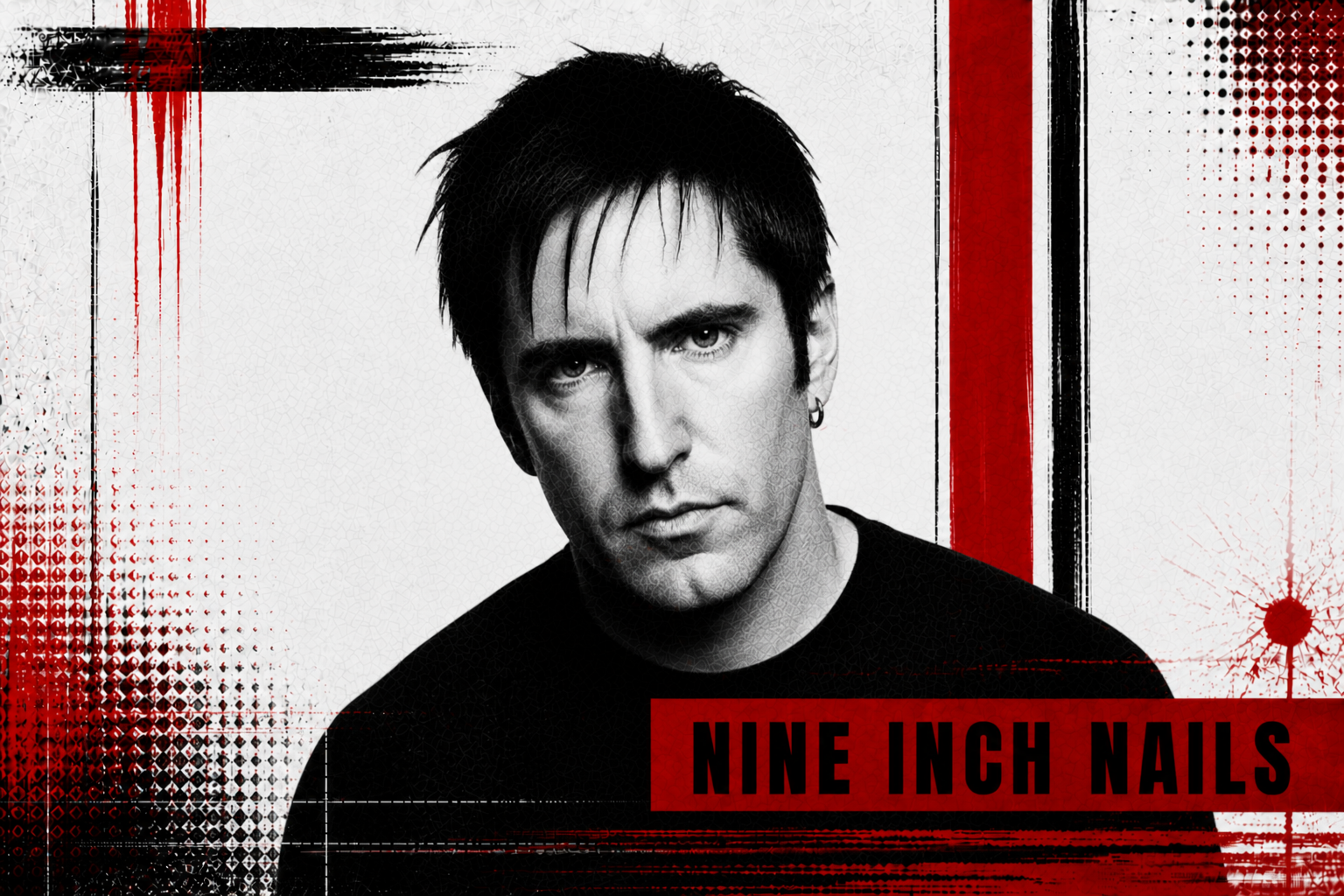
A stark fusion of industrial noise, electronic precision, and confessional songwriting defines the work of Nine Inch Nails, the project led by Trent Reznor that reshaped alternative music in the 1990s and beyond. Emerging from a landscape dominated by guitar-driven rock, Nine Inch Nails introduced a sound built on programmed rhythms, distorted textures, and layered production, creating an environment where technology and emotion function as equal forces.
Early recordings established a foundation rooted in minimal structures and mechanical repetition, where drum machines and synthesizers formed the backbone of each track. Releases like Pretty Hate Machine combined accessible melodies with darker thematic elements, presenting a balance between pop sensibility and industrial aesthetics. This duality became central to the project’s identity, allowing it to operate across multiple musical spaces.
As the catalog developed, albums such as The Downward Spiral expanded both the sonic and conceptual scope, incorporating abrasive textures, dynamic shifts, and a more fragmented structure. The record functions as a cohesive narrative, where individual tracks contribute to a larger thematic arc centered on identity and internal conflict. This approach positioned Nine Inch Nails within a broader artistic framework, where music operates as both composition and concept.
A defining aspect of the project lies in its use of sound design as a primary compositional element, where distortion, sampling, and unconventional recording techniques shape the structure of the music. Rather than serving as embellishment, these elements form the core of the sound, creating a dense and immersive sonic environment.
Reznor’s vocal delivery reinforces this atmosphere, shifting between restrained passages and intense, layered expressions that mirror the emotional trajectory of the compositions. His approach emphasizes tone and texture as much as lyrical content, integrating voice into the broader soundscape.
Production remains a central component of the project, with a focus on detail and experimentation that pushes beyond traditional recording methods. The integration of analog and digital tools allows for a wide range of textures, contributing to a sound that feels both precise and organic despite its mechanical elements.
Live performances translate these qualities into a visual and physical experience, where lighting, staging, and sound design create an immersive environment. The interplay between audio and visual elements reinforces the conceptual nature of the work, extending the recordings into a multidimensional format.
Influence extends across industrial, electronic, and alternative music, particularly in the integration of production techniques into songwriting. By demonstrating how technology can function as a creative instrument, Nine Inch Nails contributed to a shift in how music is constructed and experienced.
Throughout its evolution, the project has maintained a commitment to exploration, adapting its sound to reflect new influences while preserving a consistent core identity. This balance between change and continuity has allowed it to remain relevant across decades.
Nine Inch Nails’ legacy is defined by intensity, innovation, and a reimagining of how sound can convey emotion, illustrating how music can operate at the intersection of technology and human experience.