
ArtistDirect News
Emma Franklands No Apologies Concludes Balkan Micro-Tour, Tackling Trans Identity and Kurt Cobain Speculation
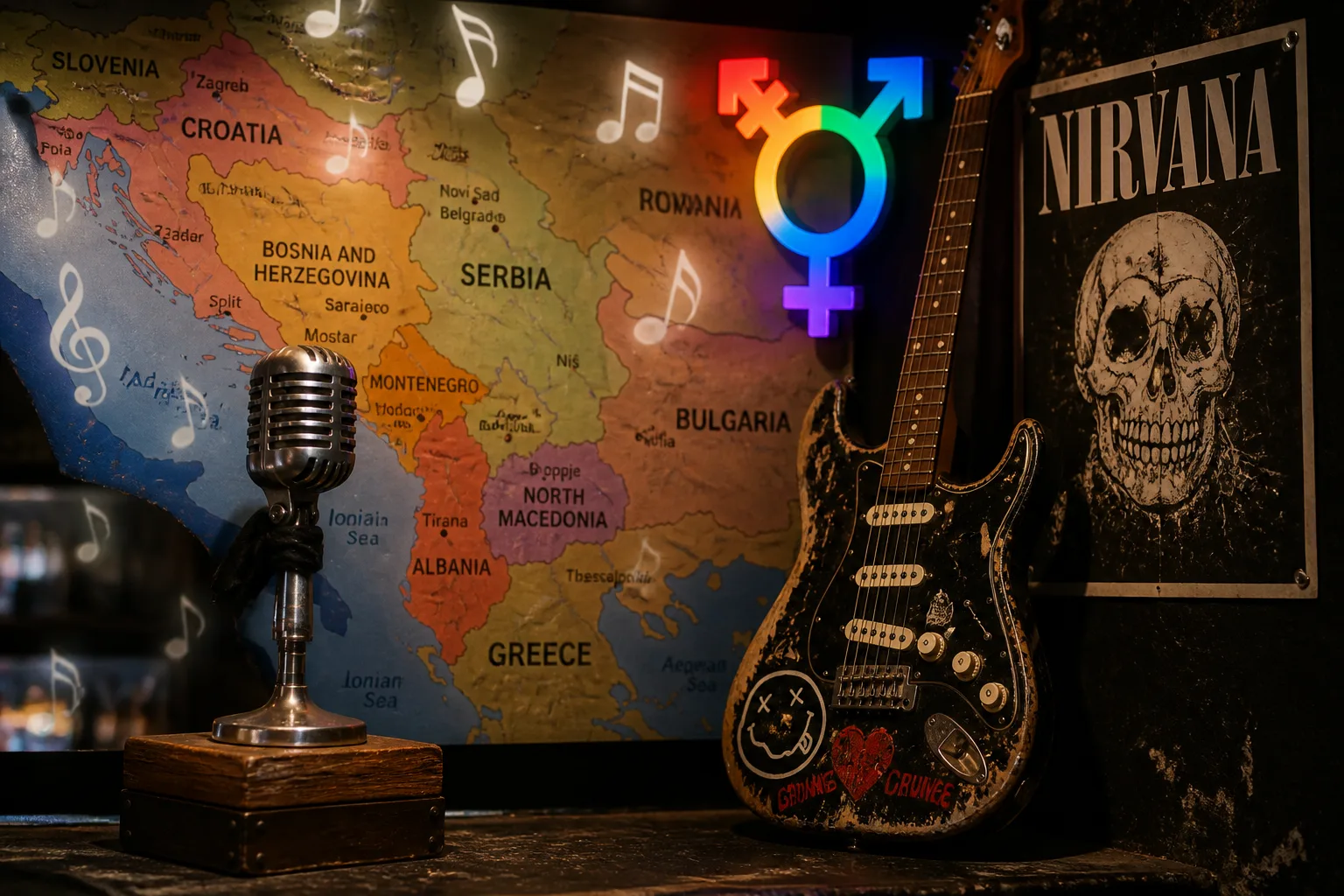
June 2026 marked the final curtain for Emma Frankland’s incendiary piece No Apologies, which ran through Prishtina, Skopje and Belgrade. The show interrogates the possibility that Nirvana frontman Kurt Cobain was transgender, and it was staged with a full band across the Balkans after its original solo debut at the Edinburgh Fringe in 2025.
Frankland, a trans London‑based artist, first staged No Apologies in Edinburgh’s Anatomy Lecture Theatre at Summerhall, a former veterinary college. The intimate solo version occupied wooden benches and featured a set that mirrored Nirvana’s 1993 MTV Unplugged stage, complete with a chandelier and lilies. Dressed as Cobain in a baggy cardigan, Converse sneakers, a cigarette burn and white sunglasses, she delivered a poetic monologue about a trans Icarus.
The production was brought to life by the queer‑led UK company Marlborough Productions and directed by Harry Clayton‑Wright. It weaves in three Nirvana tracks—“Dumb,” “About a Girl” and “All Apologies”—to explore what it might have meant for a young trans person in the early internet era. Frankland has clarified that the piece is not about whether Cobain was trans, but about the experience of being trans.
After its Edinburgh run, the piece was taken to the Balkans by Heartefact, a Serbian arts organisation, and the British Council. In Prishtina it premiered at Termokiss, a community space housed in a former heating factory, as part of Pride week. In Skopje it played at the Drama Theatre, also during Pride week, before concluding at Belgrade’s prominent Atelje 212, where it was a guest performance in an institutional venue.
For the Balkan leg, Frankland assembled a five‑piece band of local trans and queer musicians: guitarists Simona Sićović and Mateja Uzelac, cellist Ana Jovanović, drummer Luka Krupežević, and bassist Laki Krsteski from Skopje. With only a few days to rehearse together, Krsteski recalled the group “felt like we had known each other for much longer than two days.” The larger ensemble allowed the show to fill the larger Belgrade venue and added a richer musical layer to the theatrical narrative.
The tour was met with enthusiasm, though audience reactions varied. In Belgrade, Krsteski observed that the crowd was initially “nervous” and “muted,” but the moment when they began singing along became “a very beautiful moment.” The performance also featured a workshop with local trans artists, during which Frankland invited participants to tear a page from Shakespeare’s Complete Works and transform it, an exercise she says “challenges and moves people.”
Andrej Nosov, director of Heartefact, remarked that the show’s “almost physical force” moved him and that it “helped us re‑remember suffering we already know about but have somehow allowed ourselves to forget, while at the same time responding with full artistic courage to a crisis that is still unfolding right now.” He added that the show’s presence in the Balkans was “not a programme decision but a personal necessity.”
Frankland has described the show as “a show about remembering what it’s like to be 14 and trying to figure yourself out.” She also noted that Cobain “would have been an ally to the trans community.” The piece concludes with a reminder that living without apology is “not a luxury but an act of survival.”
The Balkan leg follows Frankland’s recent runs in Brazil and Germany. She has emphasised the importance of “questioning your responsibility when you’re out representing a colonizing force” and of contributing to local artistic communities rather than merely extracting stories for a home audience.
The No Apologies tour demonstrates how a trans‑led theatrical work can address historical speculation while fostering solidarity across borders. In particular, the Belgrade performances opened a dialogue about trans visibility in a region where same‑sex marriage remains illegal and constitutional barriers limit trans rights.
With its conclusion in Belgrade, the micro‑tour has taken a trans‑centric narrative from a modest Edinburgh lecture theatre to some of the Balkans’ most prominent stages, offering a space for reflection on identity, history and artistic courage.
Frankland, a trans London‑based artist, first staged No Apologies in Edinburgh’s Anatomy Lecture Theatre at Summerhall, a former veterinary college. The intimate solo version occupied wooden benches and featured a set that mirrored Nirvana’s 1993 MTV Unplugged stage, complete with a chandelier and lilies. Dressed as Cobain in a baggy cardigan, Converse sneakers, a cigarette burn and white sunglasses, she delivered a poetic monologue about a trans Icarus.
The production was brought to life by the queer‑led UK company Marlborough Productions and directed by Harry Clayton‑Wright. It weaves in three Nirvana tracks—“Dumb,” “About a Girl” and “All Apologies”—to explore what it might have meant for a young trans person in the early internet era. Frankland has clarified that the piece is not about whether Cobain was trans, but about the experience of being trans.
After its Edinburgh run, the piece was taken to the Balkans by Heartefact, a Serbian arts organisation, and the British Council. In Prishtina it premiered at Termokiss, a community space housed in a former heating factory, as part of Pride week. In Skopje it played at the Drama Theatre, also during Pride week, before concluding at Belgrade’s prominent Atelje 212, where it was a guest performance in an institutional venue.
For the Balkan leg, Frankland assembled a five‑piece band of local trans and queer musicians: guitarists Simona Sićović and Mateja Uzelac, cellist Ana Jovanović, drummer Luka Krupežević, and bassist Laki Krsteski from Skopje. With only a few days to rehearse together, Krsteski recalled the group “felt like we had known each other for much longer than two days.” The larger ensemble allowed the show to fill the larger Belgrade venue and added a richer musical layer to the theatrical narrative.
The tour was met with enthusiasm, though audience reactions varied. In Belgrade, Krsteski observed that the crowd was initially “nervous” and “muted,” but the moment when they began singing along became “a very beautiful moment.” The performance also featured a workshop with local trans artists, during which Frankland invited participants to tear a page from Shakespeare’s Complete Works and transform it, an exercise she says “challenges and moves people.”
Andrej Nosov, director of Heartefact, remarked that the show’s “almost physical force” moved him and that it “helped us re‑remember suffering we already know about but have somehow allowed ourselves to forget, while at the same time responding with full artistic courage to a crisis that is still unfolding right now.” He added that the show’s presence in the Balkans was “not a programme decision but a personal necessity.”
Frankland has described the show as “a show about remembering what it’s like to be 14 and trying to figure yourself out.” She also noted that Cobain “would have been an ally to the trans community.” The piece concludes with a reminder that living without apology is “not a luxury but an act of survival.”
The Balkan leg follows Frankland’s recent runs in Brazil and Germany. She has emphasised the importance of “questioning your responsibility when you’re out representing a colonizing force” and of contributing to local artistic communities rather than merely extracting stories for a home audience.
The No Apologies tour demonstrates how a trans‑led theatrical work can address historical speculation while fostering solidarity across borders. In particular, the Belgrade performances opened a dialogue about trans visibility in a region where same‑sex marriage remains illegal and constitutional barriers limit trans rights.
With its conclusion in Belgrade, the micro‑tour has taken a trans‑centric narrative from a modest Edinburgh lecture theatre to some of the Balkans’ most prominent stages, offering a space for reflection on identity, history and artistic courage.