
ArtistDirect News
Oregon Pianist Hunter Noack Brings 1912 Steinway to Banffs Shaw Amphitheatre on June 28
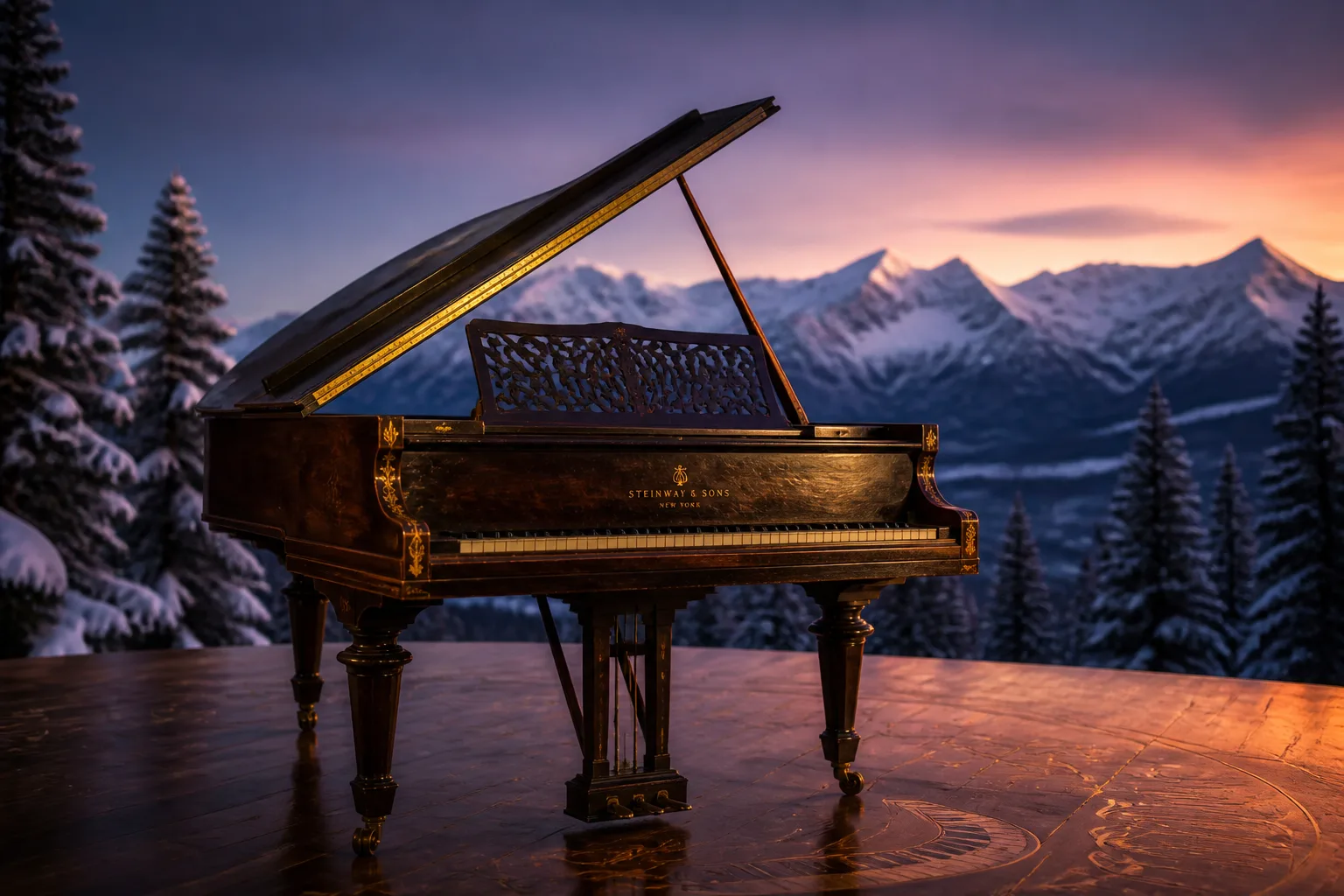
On a clear June afternoon in Banff, a 1912 Steinway Model D grand piano will echo across the ridge of Mount Rundle, inviting listeners to experience classical music in a landscape that has never been its traditional home.
Oregon native and pianist Hunter Noack will bring the historic instrument to the Banff Centre’s Shaw Amphitheatre on Sunday, June 28, 2026. The event is part of his “In a Landscape: Classical Music in the Wild” series, which has taken a single grand piano to remote outdoor locations across the United States and Canada since 2016.
Noack founded the series as a registered non‑profit with the mission of removing barriers to fine arts. His love of classical music grew alongside a childhood spent hunting and fishing in the Pacific Northwest, and a pivotal backpacking trip to Yosemite sparked the idea that a grand piano could converse with the natural world.
The 1912 Steinway, standing nine feet tall and tipping the scales at roughly 1,000 pounds, is hauled on a flatbed trailer that Noack’s team has engineered to reach any off‑road vehicle can access. Over the years the piano has survived temperatures as low as –2 °C in Big Sky, Montana, and as high as 109 °F during an Oregon heat wave, proving the resilience of both instrument and logistics. The piano’s original builder, Steinway & Sons, crafted the Model D with a wooden case and iron frame that have endured more than a century of use. The instrument’s case, painted in a deep mahogany finish, was designed to protect the sensitive action from the elements, a feature that has proven invaluable during the series’ extreme weather runs.
At Shaw Amphitheatre, the concert will begin at 4 p.m. and will be heard through wireless headphones while guests wander, lie down, or simply gaze at the rugged scenery. Noack has repeatedly adapted his programming to match the setting; for example, at the Vista House in Oregon he swapped a delicate Schumann for the raucous Rzewski after a group of Harley riders approached. Guests will be invited to explore the amphitheatre’s slopes, to pause on the grass and feel the wind, and to let the music mingle with the distant call of wildlife. Noack’s intent is for the performance to act as a sonic backdrop that enhances the landscape rather than competes with it.
Accessibility is a core principle. Each year the organization distributes roughly $100,000 worth of free tickets to people who might otherwise be unable to attend. Noack cites the Works Progress Administration’s federal music and theatre project of the Great Depression as an inspiration, noting that the WPA brought fine arts into public parks and other democratic spaces.
The Banff performance is part of the Local Journalism Initiative, funded by the Government of Canada, and the event will cover the Îyârhe (Stoney) Nakoda First Nation and Kananaskis Country. The Banff Centre for Arts and Creativity, which hosts the amphitheatre, has a long history of supporting innovative artistic projects.
Noack’s series has drawn attention for its logistical ingenuity and its commitment to making classical music accessible outside traditional concert halls. The upcoming Banff concert continues that tradition, offering a unique blend of historic instrument, natural scenery, and community outreach.
The event marks the second time the series has returned to Banff, following its debut in 2024. On June 28, listeners will hear the 1912 Steinway’s resonant tones against the backdrop of Mount Rundle, while the series reaffirms its mission to bring fine art to the public’s doorstep. The concert will proceed as scheduled, with Noack performing at 4 p.m. in the Shaw Amphitheatre. The event is expected to draw attendees who are interested in both classical music and outdoor experiences, and it will continue the series’ tradition of free, accessible performances in natural settings.
Oregon native and pianist Hunter Noack will bring the historic instrument to the Banff Centre’s Shaw Amphitheatre on Sunday, June 28, 2026. The event is part of his “In a Landscape: Classical Music in the Wild” series, which has taken a single grand piano to remote outdoor locations across the United States and Canada since 2016.
Noack founded the series as a registered non‑profit with the mission of removing barriers to fine arts. His love of classical music grew alongside a childhood spent hunting and fishing in the Pacific Northwest, and a pivotal backpacking trip to Yosemite sparked the idea that a grand piano could converse with the natural world.
The 1912 Steinway, standing nine feet tall and tipping the scales at roughly 1,000 pounds, is hauled on a flatbed trailer that Noack’s team has engineered to reach any off‑road vehicle can access. Over the years the piano has survived temperatures as low as –2 °C in Big Sky, Montana, and as high as 109 °F during an Oregon heat wave, proving the resilience of both instrument and logistics. The piano’s original builder, Steinway & Sons, crafted the Model D with a wooden case and iron frame that have endured more than a century of use. The instrument’s case, painted in a deep mahogany finish, was designed to protect the sensitive action from the elements, a feature that has proven invaluable during the series’ extreme weather runs.
At Shaw Amphitheatre, the concert will begin at 4 p.m. and will be heard through wireless headphones while guests wander, lie down, or simply gaze at the rugged scenery. Noack has repeatedly adapted his programming to match the setting; for example, at the Vista House in Oregon he swapped a delicate Schumann for the raucous Rzewski after a group of Harley riders approached. Guests will be invited to explore the amphitheatre’s slopes, to pause on the grass and feel the wind, and to let the music mingle with the distant call of wildlife. Noack’s intent is for the performance to act as a sonic backdrop that enhances the landscape rather than competes with it.
Accessibility is a core principle. Each year the organization distributes roughly $100,000 worth of free tickets to people who might otherwise be unable to attend. Noack cites the Works Progress Administration’s federal music and theatre project of the Great Depression as an inspiration, noting that the WPA brought fine arts into public parks and other democratic spaces.
The Banff performance is part of the Local Journalism Initiative, funded by the Government of Canada, and the event will cover the Îyârhe (Stoney) Nakoda First Nation and Kananaskis Country. The Banff Centre for Arts and Creativity, which hosts the amphitheatre, has a long history of supporting innovative artistic projects.
Noack’s series has drawn attention for its logistical ingenuity and its commitment to making classical music accessible outside traditional concert halls. The upcoming Banff concert continues that tradition, offering a unique blend of historic instrument, natural scenery, and community outreach.
The event marks the second time the series has returned to Banff, following its debut in 2024. On June 28, listeners will hear the 1912 Steinway’s resonant tones against the backdrop of Mount Rundle, while the series reaffirms its mission to bring fine art to the public’s doorstep. The concert will proceed as scheduled, with Noack performing at 4 p.m. in the Shaw Amphitheatre. The event is expected to draw attendees who are interested in both classical music and outdoor experiences, and it will continue the series’ tradition of free, accessible performances in natural settings.