
ArtistDirect News
Palestinian Craftsman Restores War-Damaged Ouds in Gazas Nuseirat Camp
In the shattered heart of Nuseirat refugee camp, a 60‑year‑old luthier, Suhail Abu Shawish, works quietly on a makeshift workshop that doubles as a beacon of cultural survival.
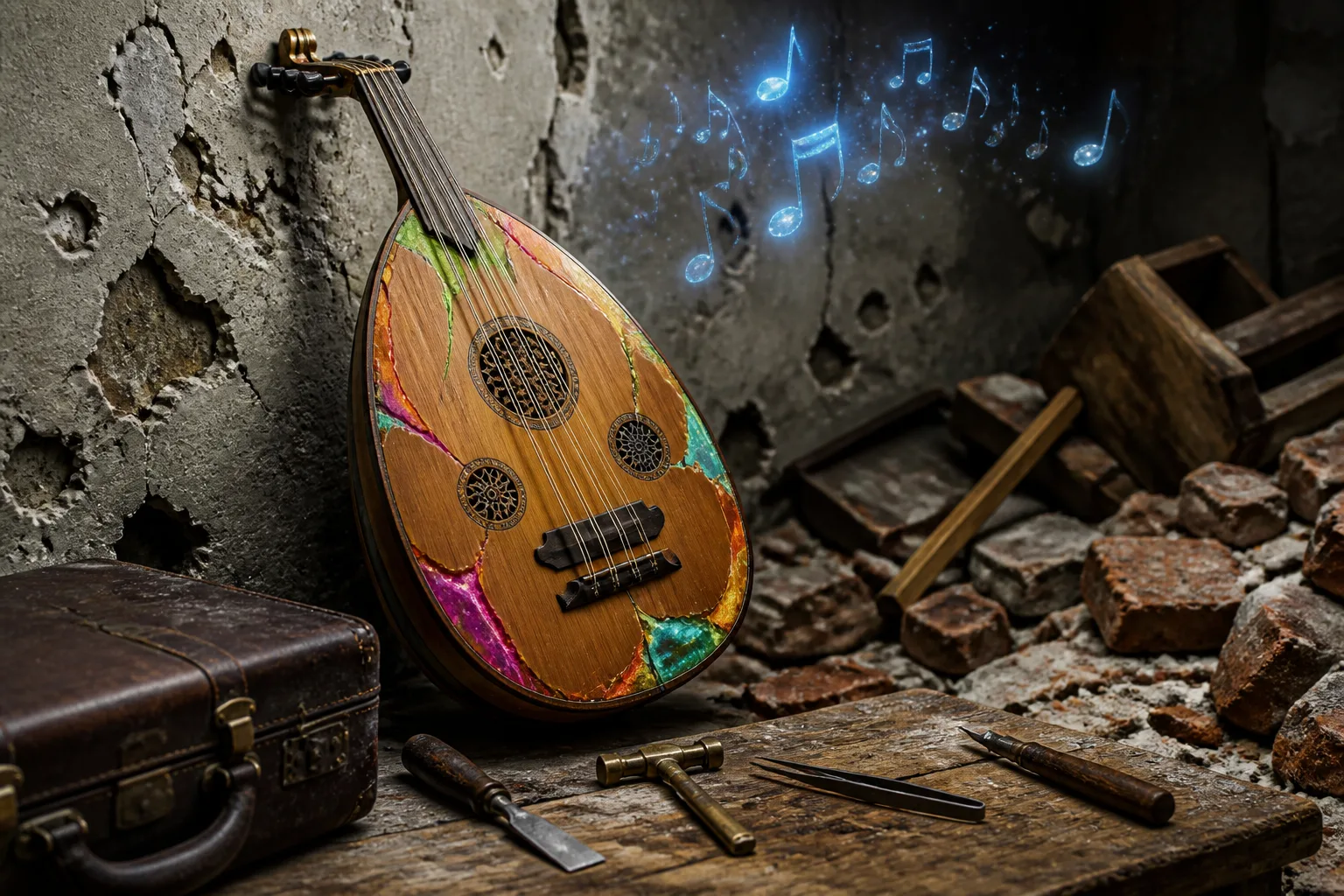
The workshop is a patchwork of wooden pallets and fragments of humanitarian aid crates, a stark backdrop for the delicate art of oud restoration. Musicians who have lost their instruments to shelling bring them wrapped in black plastic bags. Abu Shawish disassembles the damaged parts, glues them together with hand‑crafted joints, and refines the soundboard and neck using scavenged wood and hand tools. The repaired instruments are then displayed on the walls, their polished surfaces reflecting a stubborn resilience.
The oud, a pear‑shaped, fretless lute that has threaded its way through Middle Eastern music for centuries, holds a special place in Palestinian tradition. Abu Shawish first learned to play the instrument in the 1980s and later honed his craft with several conservation institutions. His expertise enables him to revive instruments many would deem beyond repair.
The ongoing blockade of Gaza and the devastation of the 2023‑24 Israeli‑Gaza war have made such restoration work extraordinarily difficult. Wood, the primary material for oud bodies, is scarce because imports are restricted and local supply chains have collapsed. Abu Shawish now scavenges scrap wood from aid boxes and reuses components from damaged instruments. Glue, once inexpensive, now costs roughly three times more, and the price of thinner has risen sharply. Intermittent electricity forces the craftsman to rely on manual saws and files.
Despite these obstacles, Abu Shawish continues his work. He describes each restored oud as a “small victory against the devastation” surrounding him. He hopes that, when conditions improve, he can produce high‑quality instruments that compete internationally and showcase Gaza’s craftsmanship.
The restoration of musical instruments in Gaza is part of a broader effort to maintain Palestinian cultural identity. Music has historically served as a form of resistance and community cohesion in Palestinian society. By repairing ouds, Abu Shawish keeps a vital element of that heritage alive for the next generation.
Nuseirat, located in the Deir al‑Balah Governorate, hosts a population of over 88,000 registered refugees. The camp has suffered extensive damage to infrastructure and homes during the war, and its residents rely on humanitarian aid. The scarcity of resources extends to cultural goods such as musical instruments.
Abu Shawish’s workshop has attracted attention from local musicians and cultural organizations. While there is no formal partnership with any institution, the space serves as a community hub where musicians can bring damaged instruments for repair. The restored instruments are returned to their owners, allowing them to continue performing and teaching.
In the broader context of the Gaza war, the preservation of cultural artifacts has become a symbol of resistance. The ability to repair and play an oud in a war zone underscores the resilience of Palestinian artists and their commitment to maintaining cultural continuity.
The workshop remains operational as long as Abu Shawish can secure the materials and tools needed for restoration. The current situation is uncertain, but the craftsman’s determination reflects a broader commitment to preserving Palestinian musical heritage in the face of ongoing conflict.
Abu Shawish’s story illustrates how individual artisans contribute to the survival of cultural traditions under extreme conditions. His work not only restores instruments but also reinforces a sense of identity and continuity for the people of Gaza.
The workshop is a patchwork of wooden pallets and fragments of humanitarian aid crates, a stark backdrop for the delicate art of oud restoration. Musicians who have lost their instruments to shelling bring them wrapped in black plastic bags. Abu Shawish disassembles the damaged parts, glues them together with hand‑crafted joints, and refines the soundboard and neck using scavenged wood and hand tools. The repaired instruments are then displayed on the walls, their polished surfaces reflecting a stubborn resilience.
The oud, a pear‑shaped, fretless lute that has threaded its way through Middle Eastern music for centuries, holds a special place in Palestinian tradition. Abu Shawish first learned to play the instrument in the 1980s and later honed his craft with several conservation institutions. His expertise enables him to revive instruments many would deem beyond repair.
The ongoing blockade of Gaza and the devastation of the 2023‑24 Israeli‑Gaza war have made such restoration work extraordinarily difficult. Wood, the primary material for oud bodies, is scarce because imports are restricted and local supply chains have collapsed. Abu Shawish now scavenges scrap wood from aid boxes and reuses components from damaged instruments. Glue, once inexpensive, now costs roughly three times more, and the price of thinner has risen sharply. Intermittent electricity forces the craftsman to rely on manual saws and files.
Despite these obstacles, Abu Shawish continues his work. He describes each restored oud as a “small victory against the devastation” surrounding him. He hopes that, when conditions improve, he can produce high‑quality instruments that compete internationally and showcase Gaza’s craftsmanship.
The restoration of musical instruments in Gaza is part of a broader effort to maintain Palestinian cultural identity. Music has historically served as a form of resistance and community cohesion in Palestinian society. By repairing ouds, Abu Shawish keeps a vital element of that heritage alive for the next generation.
Nuseirat, located in the Deir al‑Balah Governorate, hosts a population of over 88,000 registered refugees. The camp has suffered extensive damage to infrastructure and homes during the war, and its residents rely on humanitarian aid. The scarcity of resources extends to cultural goods such as musical instruments.
Abu Shawish’s workshop has attracted attention from local musicians and cultural organizations. While there is no formal partnership with any institution, the space serves as a community hub where musicians can bring damaged instruments for repair. The restored instruments are returned to their owners, allowing them to continue performing and teaching.
In the broader context of the Gaza war, the preservation of cultural artifacts has become a symbol of resistance. The ability to repair and play an oud in a war zone underscores the resilience of Palestinian artists and their commitment to maintaining cultural continuity.
The workshop remains operational as long as Abu Shawish can secure the materials and tools needed for restoration. The current situation is uncertain, but the craftsman’s determination reflects a broader commitment to preserving Palestinian musical heritage in the face of ongoing conflict.
Abu Shawish’s story illustrates how individual artisans contribute to the survival of cultural traditions under extreme conditions. His work not only restores instruments but also reinforces a sense of identity and continuity for the people of Gaza.